Comparing Amps
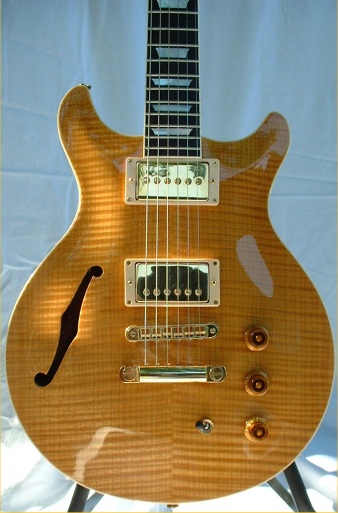
The two guitars that I brought with me were a Hamer Artist Custom and a Hamer Duotone Custom. The Hamer Duotone has a Seymour Duncan ’59 humbucker in the neck and a RIO BBQ humbucker in the bridge (as well as piezo pickups). The Hamer Artist Custom (my favorite guitar) has a Seymour Duncan PhatCat P-90 in the neck and a Seymour Duncan Seth Lover humbucker in the bridge.
I play a lot of different styles of music including rock, blues, country, folk
and reggae. I’ve been playing guitar since 1966 and a lot of that time has
included acoustic guitar, which has influenced my electric guitar technique.
About 40% of the time, I finger pick with all 5 fingers of my right hand, using
a modified Travis picking technique of keeping the bass going with my thumb
while dropping harmonies and melody in with my other fingers.
Because of
the influence of my acoustic playing, I tend to like tube amp tones that are
bright and just hovering at the edge of breakup. I’ve always felt the Deluxe
Reverb enhances my style of playing. I love to let open strings ring out and I
like to use reverb to let the sound swirl.
I also like to get down and
dirty (who doesn’t?) and enjoy playing singing leads with an edge. I also like
crunchy power cords, ala AC/DC. Could one amp handle this range of styles? To
get this variety out of my DRRI, I have to use a Voodoo Labs Sparkle Drive to
push the amp into singing sustain.
The first thing Mikey wanted to hear
was my playing style and the sounds I typically get out of my DRRI. I grabbed my
Hamer Artist Custom, switched on my favorite pickup (the P-90) and started
playing a variety of songs and leads. As you’d expect, even when using the
humbucker on this guitar, I couldn’t coach my amp into singing sustain.
Switching to the Hamer Artist Duotone and its humbuckers got me closer to this
but it still wasn’t enough to push it over the top. One thing I’ve always liked
about the DRRI though is the way it can give me enough brightness to overcome
the darker tendencies of my P-90 and humbucker pickups. I always like some top
end zing and enough crispness to let me drop into pseudo-acoustic sounds by
turning down my guitar volume.
Next up was Mikey’s rebuilt amp. Using the
P-90 pickup of the Artist Custom, I plugged into the Vibrato channel using the
exact same settings as my DRRI. I immediately liked the smooth, complex tones
that came out of the amp, which has a Weber C12N speaker. In my experience, if I
don’t like a tube amp sound within the first 15 seconds, it is unlikely that
I’ll be able to dial it in. Well, I’m here to say that I liked it right
away!
When I plugged into the Normal channel, it was noticeably louder
and had more grit than the Vibrato channel. It was also brighter, which I liked.
Using the Seth Lover humbucker, the Normal channel crunches like mad and gives a
very exciting rock and roll sound. Brilliant. I liked this channel even more
than the Vibrato channel. This isn’t your father’s Deluxe Reverb.
The
humbuckers on the Hamer Duotone have even more output and when these push the
Normal channel on Mikey’s amp, watch out! Single note leads could be coaxed into
singing, controllable sustain with just the right combination of overdrive and
clarity, much like the beautiful lead tones that Duane Allman used. With the
guitar volume at 10 and the amp volume of the Normal channel at 6, it was pure
rock and roll heaven. Mikey and I were both grinning from ear-to-ear.
With both channels in phase, it was easy to have the best of both worlds. I really enjoyed being able to dial-in cleans from the Vibrato channel and crunch from the Normal channel. It also made it easy to switch from one channel to the other to hear the sonic differences.
I also had a chance to try the Triode/Pentode switch on both channels. This has the intended effect of dropping the gain and making the amp darker. It'll be nice for some applications where I don't want to be as loud, but in general, I much prefer the Pentode setting.
Then we tried the tremolo circuit. Wow. What a difference between it and my DRRI. The tremolo has a slow, subtle, hypnotic effect that just seemed to breath. It added a lush, 3D sound similar to a UniVibe. It's like having an effects pedal built into the amp that doesn't mess with the pure tube tone. I rarely use tremolo but I can see myself using this circuit. Once again, I liked it right away.
Next, we plugged Mikey’s amp into the speaker in my DRRI cab. My DRRI has a Reverend All Tone 1250 (12” 50-watt) speaker that has always seemed just right for my amp. I'm not alone in my assessment of this speaker. On the newsgroups, it isn't uncommon to read that other players have found this speaker to be the ONE for a Deluxe Reverb.
I have a Celestion Alnico Blue speaker but I prefer the Reverend All-Tone 1250 if I'm using a single 12" speaker with this particular amp. This speaker has been discontinued by Reverend Guitars but there has been discussion about releasing this amp again.
When we plugged in and fired up the Vibrato channel, the sound was darker than when played through Mikey’s speaker. It is amazing what a difference a speaker can make!
Of note, Mikey plays a customized G&L ASAT (Telecaster style) guitar, which is bright to start with. With his guitar and brighter speaker, it's not surprising that his amp played with my guitars and through my speaker was darker sounding. Since I like a bright Vibrato channel, Mikey said he’d further modify this part of the circuit for my playing style and equipment.
I would like to add that the Vibrato channel still sounded great. When I turned up the volume on the guitar using the P-90 pickup and plucked a single note, the sound from the amp swelled and receded, swelled and receded. I always view this as a critical sign of a well-designed amp. Tube amps should breath like this. It adds so much to the enjoyment of the player and the listener. This amp has it in spades.
Switching over to the Normal channel with my speaker produced a wonderful, exciting sound that was lacking nothing. Since the Normal channel on Mikey’s amp was brighter than the Vibrato channel, my darker speaker merely complimented it. Once again, I cranked up the guitar volume, switched to humbuckers and had us both grinning from ear-to-ear once again. I loved the way the Normal channel sounded through my speaker and I told Mikey I thought he’d hit a home run with this channel.
By now, we’d been at this for 6.5 hours, it was 7:30 at night and suddenly we both started to think PIZZA. We called up the local Pizza Hut and both ordered our favorite toppings. While we waited, we grabbed another couple cans of Coke and ice and sat out in the warm, night air.
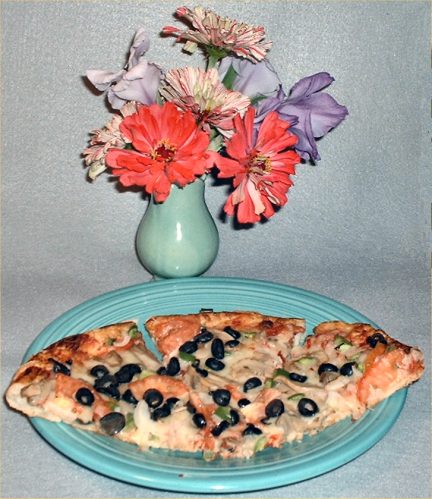
After a bit, Mikey’s daughter showed up and I got to meet and chat with her for a bit. It was nice to meet a member of his family and see this side of his personality. I got to interact a bit more with the friendly cat when the doorbell rang and the pizza arrived.
We sat outside as the sky darkened, enjoying the pizza and our further tone conversations. I was really excited by what I had just heard and Mikey was charged up by the enjoyment he could see in me. We talked for quite a while about the subtleties of tone and the qualities of the Normal and Vibrato channel through my speaker. Mikey spoke of refinements to the Vibrato channel that he could make so that it would better match my speaker, my guitars and my style.
Mikey said this type of tweaking to a player’s preference is at the core of his design approach. He pointed out that walking into a store and buying an amp, even an expensive boutique amp, doesn’t guarantee a match with a player’s guitar and style. He said he has chosen the AB763 circuit used in the Deluxe Reverb (and many other Fender amps) as a good starting point in trying to give a player customized solutions. He was proving it by me!
Mikey had a couple more things he wanted me to try, so after this relaxing pause we returned to the shop and fired up his amp into my speaker.
This time, Mikey had me play through the Normal channel while he adjusted the midrange pot on the back of his chassis. Using both guitars and all pickups, I played a variety of licks and songs, listening for the subtle and not so subtle changes he was able to elicit with this control. It became apparent that my favorite setting was right between 11:30 and 12:00 on the pot. Mikey will build a resistor into the circuit of the Normal channel of my amp to give me my preferred mids setting.
We went back to the Vibrato channel and listened again, particularly to the volume and the brightness. I told Mikey that I liked the smooth, 3D sound of the channel but would enjoy a volume level a bit closer to the Normal channel as well as a brighter sound. Of course, the Normal channel should have more gain than the Vibrato channel so that when I’m playing, I can step on the A/B/Y box and kick in with a lead sound. To get the brightness but retain the smoothness, Mikey referred again to the use of his Cap Stacking method and how he could use this to get what I was after. He made some notes and I could see that he was really interested in redesigning this part of the circuit.
Mikey suggested we try swapping some 12AX7 tubes in various stages of the amp to determine which tubes would most enhance what I was looking for. We primarily focused on the V2 position, which originally had a JJ in it. We had some nice tubes to try including the new Groove Tubes 12AX7-M (Mullard copy), a JJ, an EH and an old Telefunken. The Telefunken tube may have been at the end of its useful life. It was the noisiest of the tubes and was just so-so in terms of tone.
The GT tube was darker but added a nice swirly, lush tone. It was also the nicest feeling tube from my perspective, giving me the sense that my strings were rubber bands that I could really use to change the dynamics. The JJ was pretty quiet but was darker than the tube that I thought sounded the best, which was the Electro-Harmonix. This tube was the brightest of the bunch, had a low noise level and produced nice, swirly harmonics. When switching to the Normal channel, this was the tube that rocked out the best and gave the best, singing sustain. Even with this tube though, the Vibrato channel needed more brightness, which Mikey is only too happy to accommodate.
It was now after 10:00 so we decided to stop for the day. I packed up my guitars, left the DRRI for Mikey’s ministrations, and carried my stuff out to the car. Mikey and I stood outside for a bit talking about our day and what was to come next, the actual building of my amp. We could have kept talking for hours more but since I had a bit of a drive ahead of me, I wanted to get on the road while I was still charged up and alert. All the way home, I reflected on what a fine time I’d had at Mikey’s shop and of all of the new things I’d learned.